
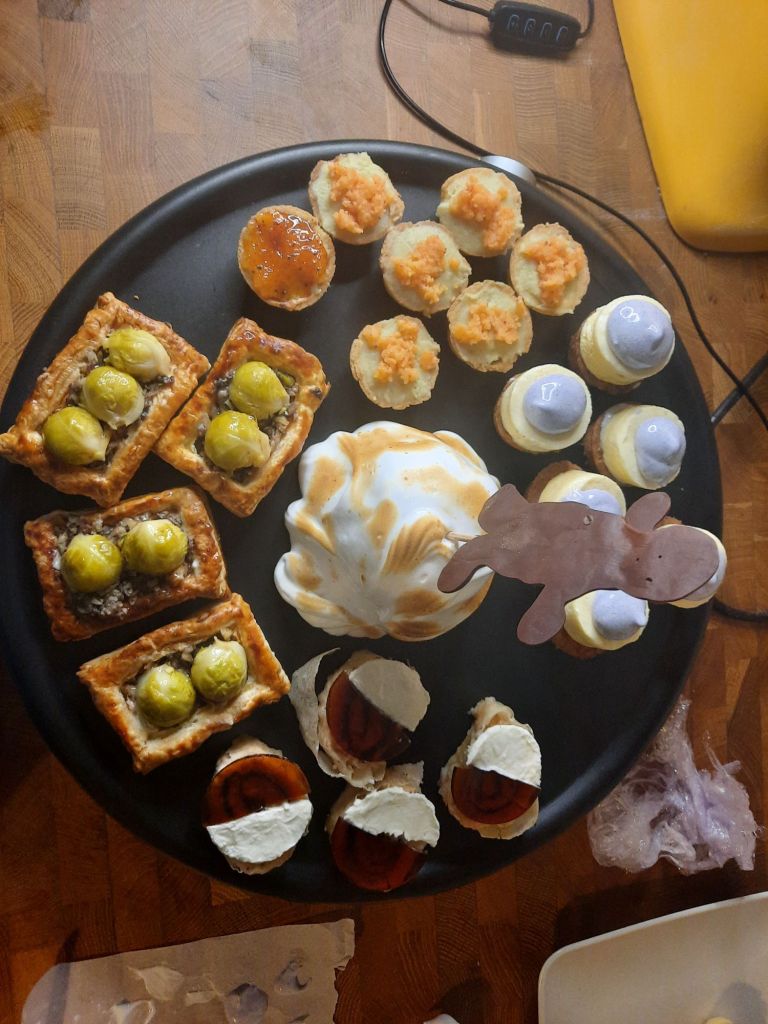
Hello there. It’s me again (the Literary Onion, for those that may be new). In thinking of stories that I wanted to put on my list to turn into dishes, Avatar: The Last Airbender was always high up on my list. It’s one of my favourite shows with some of the cleverest writing and best character and world-building out there. All of this is an amazing feat but put on top that it’s a children’s show that broaches some very heavy, very real topics, makes it even more impressive. It’s a show that I introduced even to my very anti-animation family and made a firm favourite in my household. (It’s also a show that I can barely find any merch for, along with Percy Jackson… So, if anyone knows of any, send links my way. Or bug Nickelodeon and Disney to release more merch already—other places as well as in America, please).
I had a lot of ideas (as usual) for what I could make or what I could focus on from the themes etc. of the show. Ultimately I chose one that really is the basis of Avatar: The Last Airbender; it even starts the show every episode: ‘Water, Earth, Fire, Air—only the Avatar is the master of all four elements’. The Avatar, at it’s core, is a representative of the four different nations and the four different bending styles. Whilst they may be born to one race of person, they belong to everyone—they have to be unbiased and fight for all the nations, even if it may be hard.
Even though I knew it would be hard, and a lot of work (spoiler alert: with all the concept work, recipe writing and cooking, it was indeed a lot of work), I knew I wanted to make a dish representing each of the four nations and an Avatar dish that represented all of those nations come together.

I could have made a 5-course meal, an Afternoon Tea, a Dessert Platter etc. The options were not entirely endless but they were numerable. Whilst working on the concept I thought of many different items that could represent each nation. I had many different dish concepts swirling around my head and even some different ideas written down but they didn’t feel like they went together. I wanted the dishes to be connected to each other, to share similarities but still keep their differences. After all in the show one of the major lessons whilst travelling around this world was how similar each of the nations were, despite all the differences they used to try and separate themselves. Eventually I came up with an idea for the Fire Nation that lit a torch in my head. If I went with the canape sized tart for the Fire Nation, is there a way to make each of the parts some kind of pastry for each of the nations? All different pastries, perhaps, but all ultimately the same—all pastry?
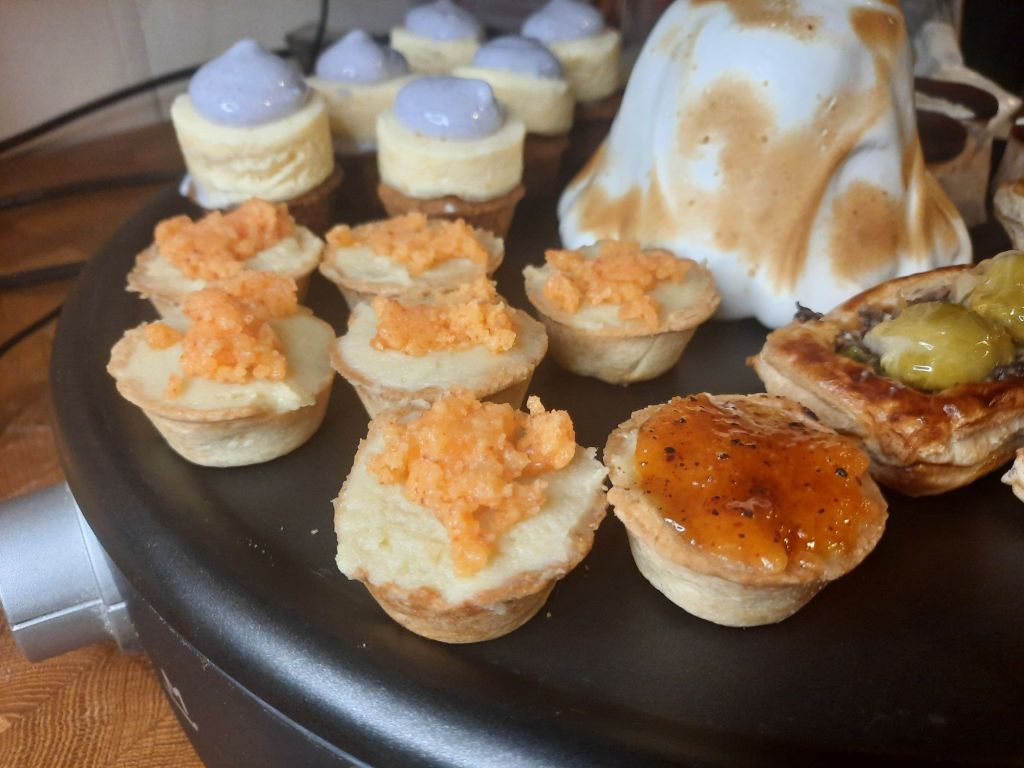
The easiest recipe to write was the Fire Nation recipe. I’d seen Crème Brûlée tarts on TV many times. I’ve made all different variations of custard throughout my time doing my Professional Cookery course and beyond (see my old blog post: Why Making Custard Is One Of the Most Important Skills To Master). I knew how easy it was to infuse a custard with flavour by just adding the flavouring to the milk, leaving to infuse and then adding to the eggs and sugar. One of the first flavours that came to my mind when starting to plan the dish was Iroh’s tea.
Iroh is an extremely integral character for both the growth of the other characters (especially Zuko) and showing the more human, good, less black-and-white side of the Fire Nation. A big part of Iroh’s character, and his greatest love besides perhaps Zuko and his son, is tea. When it came to deciding which tea to use I decided against the flower that Iroh drinks in the Earth Nation, poisoning himself ( just joking of course. I don’t even think I’d be able to source it, let alone be able to drink it), and instead decided to use one of his favourites. A bit of research online told me his favourite was Ginseng but, permitting I could find it, I decided instead to use Jasmine. Jasmine, as fans of the show know, is the name of Iroh’s tea shop (‘The Jasmine Dragon’) in Ba Sing Se. So Jasmine Tea infused custard would be my main flavour base for my mini Crème Brûlée tart.
Crème Brûlée tarts don’t work exactly the same as an actual Crème Brûlée. The actual version of a Crème Brûlée is baked in a bain-marie in an oven (a deep tray with water halfway up the pots holding your custard). It’s this baking that sets your Crème Brûlée and creates that lovely creamy texture. Unfortunately it’s not possible to do this when you put a custard into a tart shell, instead of a pot, so I had to use other means to thicken the custard. So instead of making a proper thin Crème Brûlée style custard, I made the base of Crème Patisserie using corn flour as my thickener. This provided me a creamy texture for the inside of my tarts.
To create the top, crisp ‘burned sugar’ shell of my tarts I looked to another part of the show. When visiting a Fire Nation festival the Gaang pick up a packet of ‘Fire Flakes’. Obviously we don’t know what they actually were, other than they seemed spicy—maybe? I decided to make a Chilli-Caramel, blend it up and create a flavoured, spicy sugar layer I could then melt with a blowtorch to create my Crème Brûlée top. The colour of the ‘Fire Flakes’ is a light orange like fire and the flavour creates an additional layer of unique and interesting flavour on top of the lightly floral, sweet tea custard. The hardest part to make was the pastry bases as, because I used a basic sweet pastry, it was very crumbly and very fiddly to put into the mini-pie moulds without them breaking up. Thankfully they were worth the effort as they tasted delicious.
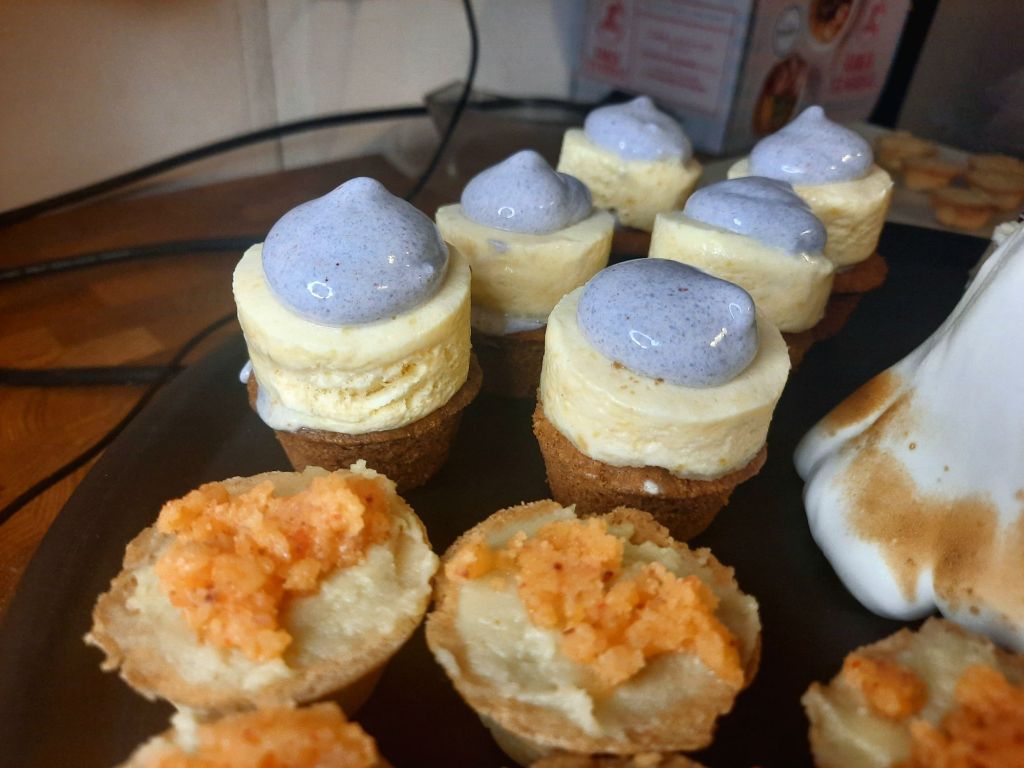
The next idea that came to me was for the Air Nation. In the show we see Aang helping Monk Gyatso make ‘Fruit Pies’ that they then send splattering over the heads of other monks below them. Aang’s relationship with Monk Gyatso is a big part of who he is and it’s the sense of humour and fun that he gained from his mentor that kept him sane throughout his war with the Fire Nation.
I looked online for pictures from the show so that I could make something that resembled them, with ‘fruit’ as my key element. Whilst looking at pictures from the cartoon I stumbled onto pictures of other people’s real life interpretations and every one that I saw was some kind of cheesecake with a fruit filling in the centre. I considered making a cheesecake but ultimately decided against it. I wanted this dessert to be really light and airy, both because I wanted them to be canapes (a light piece of food that won’t fill you up) and because I wanted to mimic the air you see Aang and Monk Gyatso use to fill the dessert.
I decided on a Galette Breton biscuit for the base. These are small, very buttery and very puffed up biscuits from Brittany in France and they’re incredibly delicious. They’re also, helpfully, very full of air as they rise and become light and crumbly as they bake. I added some black pepper to the base mix to add a bit of a floral, spicy taste to balance out my fruity topping (see my recipe for Salted Caramel and Pepper Madeleines to really get a taste of how much I like to add pepper to places it usually isn’t).
For the fruity topping I decided to create a bavarois—because apparently I really like to challenge myself and I’m crazy for it. Bavarois is a dessert I’ve made many times, specifically when studying Cookery at college, but that I haven’t made at all since then. Whilst it’s a delicious, elevated version of a mousse it’s also extremely time sensitive as you have to make sure you add your whipped egg white and whipped cream at exactly the right time to your custard base or it won’t work. Crazily, I also decided to go one step further and try to use Agar-Agar to set my bavarois rather than gelatine. I’d never used anything for bavarois other than gelatine before but I realised after writing my recipe that Aang and the Airbenders were vegetarian (again a big aspect of Aang’s character and the culture of the Air Nomads). I couldn’t use gelatine as it was derived from animals, but I could use Agar- Agar as it was derived from seaweed. I have used Agar-Agar before (and did again throughout these recipes) and I knew that it didn’t quite set the same as gelatine but if you used the right ratios it should be okay regardless.
Did I use the right ratios? No, of course, I didn’t. Stupidly I calculated wrong, forgetting to add the quantities of cream and egg white into the equation and so my bavarois didn’t set. But LO, you may ask, isn’t that the bavarois sat on top of the biscuit? Did you make it again? No, I didn’t make it again. Luckily, as a trained chef, I’m good at improvising and thinking of solutions to problems (this is one of the main skills I think you learn training to be a chef, and one of the most helpful—that and being able to keep a cool head when things go wrong). I quickly put the bavarois into the freezer and then, when I was ready to go, I cut circles of the frozen bavarois out and placed them on top of the biscuits. It tasted great and when allowed to come back to temperature slightly was exactly the texture I’d been hoping for in the beginning (near enough anyway—it was also good frozen, like a fluffy ice-cream). In the recipe that’s soon to follow in the next few weeks you’ll see that I’ve adjusted the quantity of Agar-Agar to the correct amount so that you, hopefully, won’t have to deal with this. However, if you want to put it in the freezer anyway I wouldn’t blame you—it’s tasty.
Originally when planning this dish I considered making a couple flavours of fruit bavarois to mimic what seemed to be different flavours in the original animation. Instead of that, to make my life easier (and yours if you decide to make them), I decided to link the flavour back to another Air Nation character: Momo. Momo is the group’s flying lemur and the last lemur left at one of the Air Temples they visit early on. Momo means ‘Peaches’ in Japanese. I’d love to tell you there was a deeper reason for my fruit choice but there really wasn’t. Momo= Peaches. That’s it. So a very tasty orange blossom and Peach Bavarois it was.
To create my Airy Topping I decided to use a dyed Swiss Meringue to reflect the air Aang and Gyatso fill the pie with. Swiss Meringue, even more so than Italian or French Meringue, is filled with air as it’s whipped over a stove-top bain marie creating a large fluffy cloud of sugar. The steam from underneath the bowl creates a similar effect as the Air-Benders as it fills my meringue with air (ready to drop on somebody’s head from above, of course). The meringue tops the bavarois, the bavarois (stuck down with a bit more meringue) tops the biscuit and voila, we have an Air Nomad Fruit Pie.
The Earth Kingdom pastry came to me in concept long before the recipe was ever finalised (it was actually the last recipe I finalised, only a few days before cooking). In the Earth Kingdom we constantly run into a fan-favourite character who is constantly fighting for his life—and his livelihood. I am, of course, talking about ‘the Cabbage man’. Finally, with this pastry, I could make sure his cabbages wouldn’t be destroyed and would instead be savoured and enjoyed.
My original idea was to use a Brussel Sprout as my representation of a cabbage as they are essentially mini cabbages and whole would look like the cabbages on the Cabbage Man’s cart. However, unsure of whether they would still be in season by the time I cooked this (my local shops in France are very seasonal with produce), I actually planned for a different dish involving choux pastry resembling cabbages with a cabbage filling. It was a gamble of an idea I wasn’t certain would actually work. Luckily when shopping just before I planned to cook I discovered sprouts were still in the shops and I quickly changed my idea back to its original form.
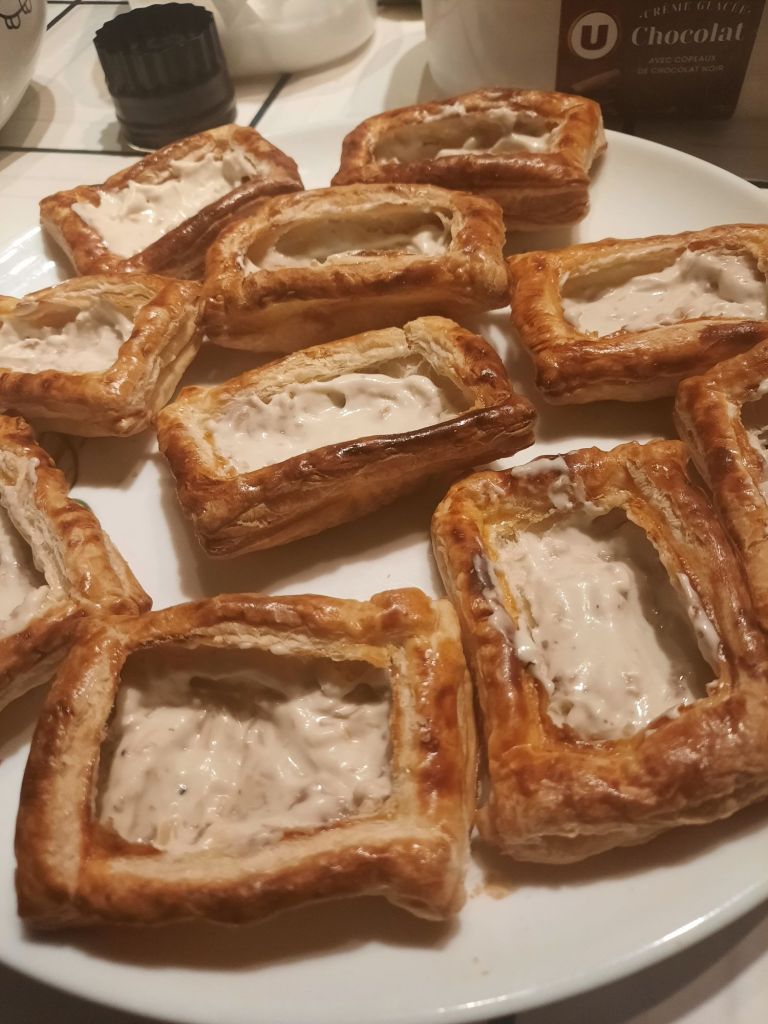

The base of the canape is a rectangular vol-au-vent puff pastry case to act as my ‘Cabbage Cart’ and it’s filled with (bottom to top): a blue cheese and caramelised shallot mousse (for saltiness, sweetness and sourness from the vinegar in the shallots); a mushroom, apple, nut, rosemary and garlic layer (to add the ‘Earthy’ flavour to the Earth Kingdom and add texture); a top layer of apple-juice infused Brussel Sprouts (for the ‘Cabbages’ in my ‘Carts’); and a top layer of Apple-Jelly Glaze (using Agar-Agar yet again. This was mostly just to give the Brussel Sprouts a lovely sheen and add some more sweet apple flavour to balance out the Earthy Mushroom and Salty Blue Cheese Mousse). This was the easiest of all the dishes to make because each part wasn’t too complicated. It was a canape that really focused on a few specific ingredients and came together magically. I’m extremely happy that Brussel Sprouts were still in season as they were the favourite pastry on the entire platter for both my Mum and Dad. If you like blue cheese, and sprouts are still in season, I would highly recommend making them when the recipe is posted (the Follow button is somewhere around here if you want to be kept updated for when it lands—unless, of course, you’re reading this in the future when it’s already posted, in which case—Follow and be updated on other awesome things that may come out—please?).

The Water Tribe Pastry was the hardest to plan and took the most research. I wanted to really represent the place that they came from so I did research into the diet of people who live in cold climates, specifically Inuit food and Icelandic dishes (although there were other Cold Climate influences too). What I discovered from my research, including looking up references to Water Tribe food in the show, is that they feature a lot of fish in their food. They import a lot of different ingredients, including a lot of vegetables, and include seaweed in many dishes as it’s accessible to them. I read a person’s account of his time in (I think it was Iceland, but I can’t fully remember for sure) and looked at some menus from restaurants in the regions I was looking at and found many mentions of dipping fish into soy sauce. The traditional food seemed to be very focused on fish because it’s what’s available in colder climates. I know that Norway, for instance, provides a lot of salmon etc. to the rest of Europe for this reason.
I decided on going back to another older concept I used years ago back when I entered a Cookery Competition in my county. I decided to make a ‘steamed fish sausage’. I used to make this quite a bit at College with salmon cream wrapped in leeks. For the competition I used a more local fish: smoked herring. For this dish I decided on using mackerel for one smoked sausage, wrapping it in sushi nori sheets to represent the seaweed frequently mentioned in my research. I added some coriander and lemon juice (as well as the cream and cream cheese to get the right texture) to really boost the flavour, something I again saw frequently mentioned as imported ingredients to colder climates (mainly the lemon, I just liked the flavour of the coriander more than other herbs with this dish). I made another layer of the sausage using salmon, to represent Norway, Sweden etc.’s frequent use of salmon (it’s also easy to buy where I live so a good bulking agent for the sausage to add a real depth of fishy flavour). The whole sausage was then wrapped in brick pastry and baked (I never found Brick Pastry in the UK but it’s seemingly everywhere in France. If you make this dish and can’t find Brick, use Filo Pastry but use more layers of it stuck together with melted butter for the best results).
When cooled and sliced into canape sized slices there was a lovely swirl inside created by the two fish layers and the seaweed that really mimicked the swimming of the fish in the pond at the North Pole.
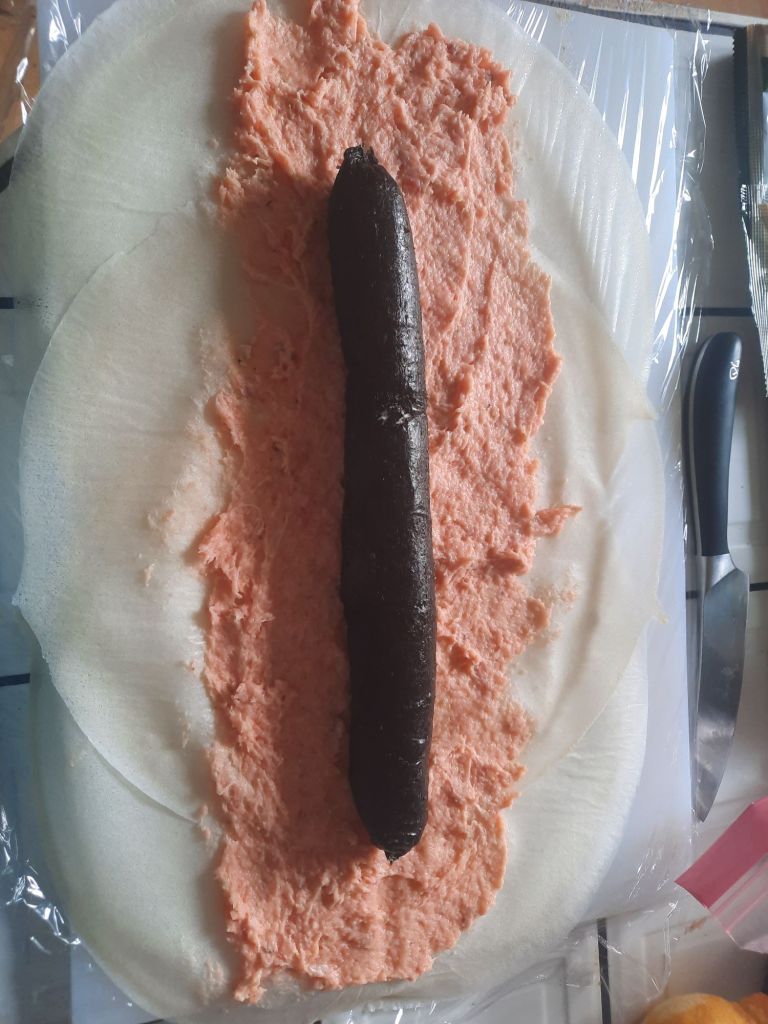
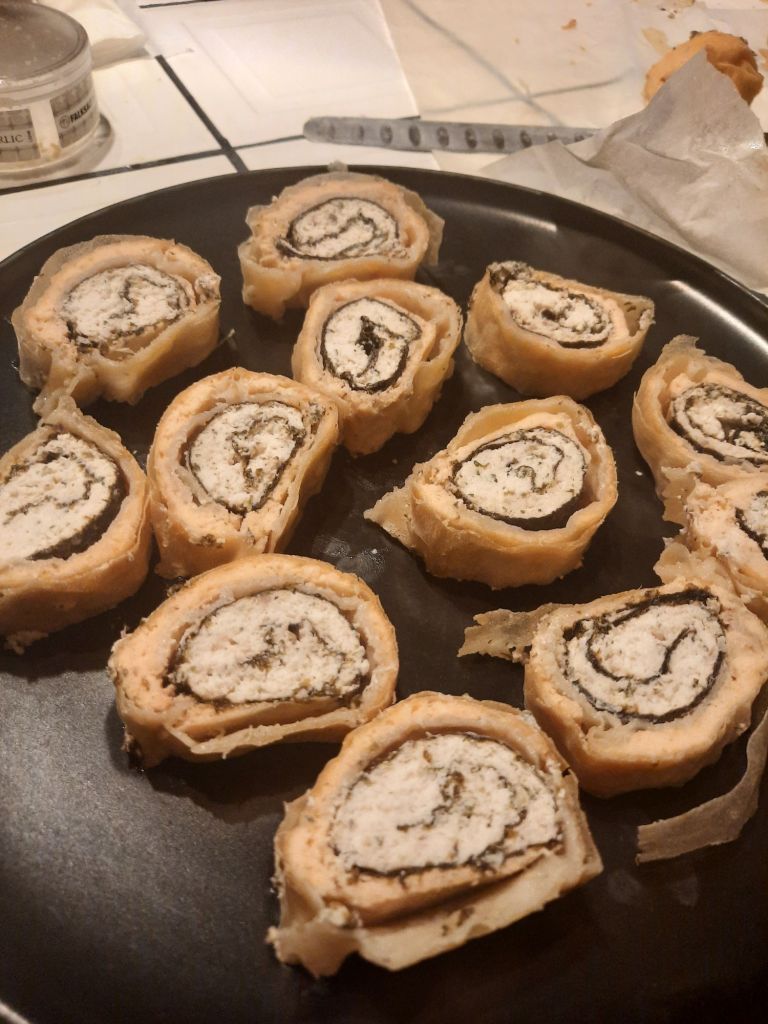
Speaking of the fish, though it took a while to come up with the recipe/idea for the main body of the pastry, I knew what I wanted the top to resemble from the beginning. I wanted to create a Yin/Yang top with a black-ish semi-circle on one side and a white semi-circle on the other side. Originally, before researching, I considered using sesame seeds to get this effect, but after researching I found that sesame seeds didn’t seem to appear in the food of these climates too much (at least from all that I read). Soy Sauce, however, crept up more than once. As a bonus soy sauce would add a lovely saltiness to my pastry.
Agar-Agar appeared in my mind again (maybe it was because I was thinking of the seaweed in my research? This was actually the first recipe I planned Agar-Agar for before the other uses were ever considered). At College I’d made both a Carrot Jelly and a Balsamic Jelly set with Agar-Agar. They were phenomenal and since then I’d experimented a couple more times with different flavoured jellies set with Agar-Agar. It was a no-brainer to use Agar-Agar again this time to make a Soy Sauce Jelly layer to sit on top of my fish rolls. I used Sweet Soy Sauce to add an extra dimension of flavour and also added some lemon juice for a sharp note. It was set in a thin layer and cut into half-circles. I don’t know why I was so confident it would work. Really, I shouldn’t have been as I wasn’t at all sure it would work or that it would work with the fish roll—but I never even questioned it. Unlike the Choux idea in the Earth Kingdom design, I was sure it would work, though I don’t know why. In the end I was… right? Yes, I’m just as surprised as you. The jelly added a level of seasoning and complexity that would have been missing otherwise… and, as a bonus, they were a perfect Yang representation.
The White half was also an easy solve, but another one that I don’t know why I was confident with as it’s not anything I’d ever seen anywhere else. Knowing how well crème fraiche worked with fish (adding creaminess and a hit of sourness) I froze a sheet of spread out crème fraiche and cut half-circles for the Yin side of my circle. Again, maybe it shouldn’t have worked but it did exactly what I wanted to. It balanced out the flavours of all that was around it and aided the fish. Overall the Water Tribe Pastry was my favourite as the flavours and textures, when put into your mouth at once, blended together perfectly. They were exactly in balance, just like Tui and La in their North Pole pool.

The last part of the dish was also going to be the biggest. It was the Avatar. It had to stand out on the plate—maybe even tower above the rest. I knew that I had to wait for the other recipes/concepts to be completed before I worked on it as I wanted all the flavours in each Nations pastry to be represented in the Avatar. Ultimately I decided on: the Crème Fraiche and Soy Sauce from the Water Tribe, the Tea from the Fire Nation, the Nuts from the Earth Kingdom and the Meringue from the Air Nation.
I originally planned to make an Asian-flavoured custard tart for the centre (not using any of those above) but when I decided to use the flavours above instead to create an All-Nation Avatar another idea shot into my head. Although the last episode of the show was called Avatar Aang, what was Aang at the beginning of the show? ‘The Boy In the Iceberg’. I could make an Iceberg to represent Aang appearing into the world, starting the show and their journey. I looked back at the ingredients I could use from the other dishes and settled on the idea of doing a Baked Alaska: a cake base, ice-cream centre and a blow-torched meringue covering the entire thing (I would love to say that the blow-torching was to represent the Fire Nation hunting and attacking the Avatar, and I will say that as well, but mainly it was to add some crispness to the meringue).

The ice-cream uses an infused tea-milk, similar to the custard from the Air Nomad Pastry, but is mixed instead with crème fraiche and other ingredients, frozen and churned to make a sour-sweet, floral-tea flavoured centre. The meringue is the same Swiss Meringue from the Air Nation dessert as well but with no dye mixed into it. The sponge for the base is another commonly made, by me, sponges: ‘A Jaconde sponge’ which is essentially a Swiss Roll/Roulade with additional ground almonds (for ‘nuts’ from Earth Kingdom) and melted butter. This makes a really flexible, airy and soft sponge. I added some extra twists to the sponge by baking the same chopped nuts I added to the Earth Kingdom Pastry into the base to create a lovely crunch in my ‘Iceberg’ and, after baking, I brushed on some of the Sweet Soy Sauce for an additional saltiness to counteract the sweet flavours. It may sound strange but it tastes divine, even when eating the cake alone (the cake was my Mum’s favourite part of any of the sweet dishes).
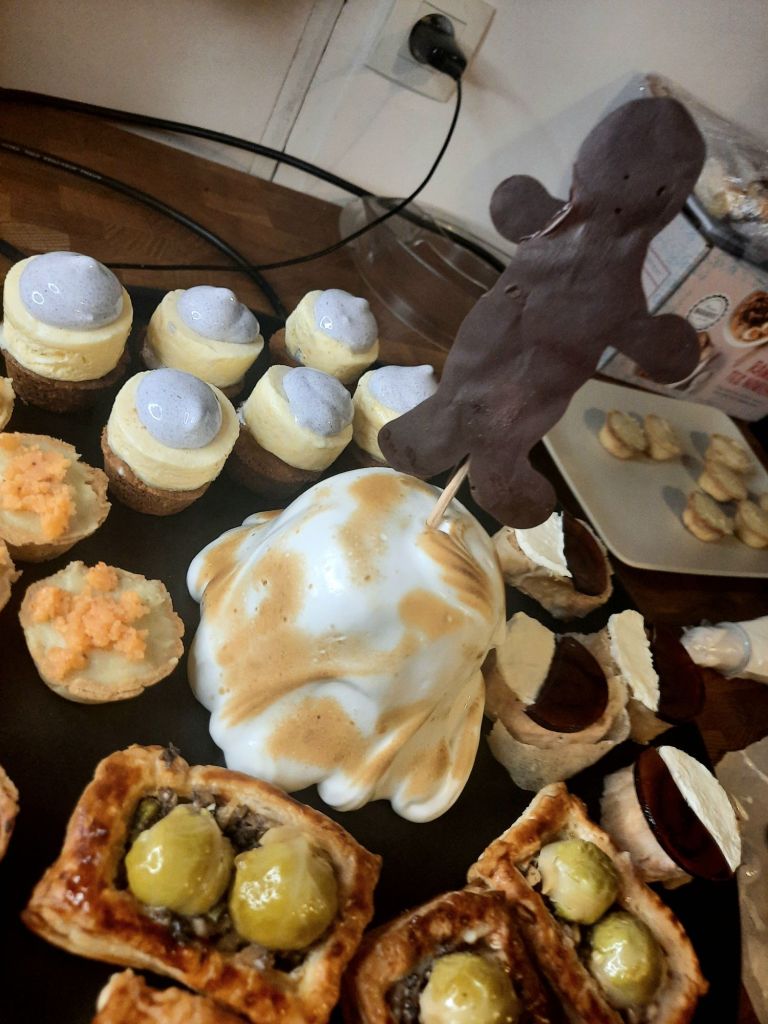
I topped the Iceberg with a roughly piped figure of Aang. Yes, it’s not great. Yes, it was the best of the three I did… and, yes, I had to reattach his arm when he got a little broken. Next time I should draw the figure on the baking paper before I pipe it but with all I had to do I didn’t quite manage to perfect it. I could’ve also left it off—and I’d love to say that I realised that at the time—but after too much debate I put it on there, not wanting to let chocolate go to waste. If you do this dish and want to create an Aang for the top I’d recommend either drawing the shape on the other side of your baking paper so that you can get the exact shape—or honestly just print one off the internet, cut it out, stick it to a cocktail stick and stick it in the top instead.
And that’s it. That’s not too much, is it? Overall it took many weeks working on the concept, a week/a week and a half to complete the recipes and 4/5 days to complete the cooking (with many stops and pauses, except for the last two days where I was in the kitchen for probably around 12-13 hours overall). I may have pushed myself quite hard for this one, which made my Mum declare that ‘we weren’t doing the next one for a while’ (clue to the next one: Three fingers in the air whilst whistling. Place your guesses below), but I think it was worth it for the end product. The canape/small pastries platter was all delicious, all representing the nations they represent perfectly (in my eyes) and were all fun. I hope if you decide to make these, you enjoy them as much as we did… and I hope for a successful Live Action Adaptation of one of my favourite shows/series to ever exist (seriously, I’ll even accept Legend of Korra merch, Nickelodeon, please—anything).
Thank you for reading and stay tuned for the next 5 weeks as I release one recipe a week for each part of this platter. If you want to donate to help fund future projects (seriously hours were spent on this, guys) there’s a donation button underneath this post. We’re thankful for any donations so that we can keep making these for you (if you can’t afford it or don’t want to, that’s okay, I know times are hard right now). There are also plenty of other types of posts in the drop-drown menu above so read and enjoy whatever you’d like to. Okay, I promise I’m done now.
Signed,
The Literary Onion
P.S. What, you thought I’d be gone by now? Is this the first time you’ve been reading my blog? Oh, it is? Oh, well, sorry—I quite often add a P.S. afterwards with other bits of information not included in the main body of the text. This time I just wanted to tell you—thank you. Thank you for reading this, for donating (if you have), for sharing with others (if you have), for following my blog (all 56 of you) and for liking my work. I’ve been asked why I wanted to keep my blog with both Food and Writing, instead of just focusing on one, and the answer is simple: because I love both, can’t afford to run two separate blogs (anymore), don’t have the time to run two separate blogs and find it way more enjoyable to break up the monotony of doing either without the other by having both so I can take breaks from doing either. I love Food and I love Writing and I love Writing about Food and making Food about Writing. It’s all just… fun. And I hope you had fun reading and hope you have fun continuing to read. Okay, I’m really going now. Have a great rest of your day or great tomorrow if, like me, you’re reading this when it’s already nearly the start of a brand new day.

 The Literary Onion