
Well, hello there again. Long time, no see, isn’t it? For that I can only sincerely apologize—especially to the rare people out there who were actually following this blog. You see what happened is—I threw myself too heavily into the murder of a woman that showed up just outside my town—in the woods (I live near woods, in case you didn’t know/I’ve never told you). It was a tragic case. Nobody could solve it. She didn’t have much on her apart from a library card and a locket, neither of which could be traced to anything of any importance. It was surreal—And by that I mean it was literally unreal. I only awoke from the witches spell on me last week. Ever since then it’s all been about trying to pick myself up, deal with the trauma and trying to get back to doing what I was doing before. Finally, finally, after how many months the spell took from me I can finally turn back to doing what I love most: finding a fun story and turning it into a plate of food.
Luckily for me, a new program had just come out from Marvel Studios called ‘Agatha All Along’—and that program seemed… eerily familiar. And I mean, eerily familiar. So much so that I wondered if the spell had been broken after all or whether I was still under it.
Anyway, I decided to make my dish based on the amazing Road that opened under my feet after repeated playing and singing of the ‘Witches’ Ballad’ from ‘Agatha All Along’… So I guess, here goes:
Jokes aside, I’ve really been enjoying Agatha All Along so far. At the time of writing the fifth episode has just come out and I’m anxiously awaiting for the sixth (and praying that they’ll stop getting rid of my favourite characters—even if it makes sense for the plot). By the time that you see this we’ll be nearing the end and I’ll be rewatching every episode trying to pick up on every clue they could’ve possibly left behind.
I actually decided to make a dish on this show around the time that they released the trailer and had the cast appear singing the Ballad at the D23 convention. The aesthetics of the Road, the costuming, the witch-vibes: all of it screamed out to be made into the perfect autumnal, Halloween-y style dish. I knew I wanted the dish to represent the road. I wanted earthy flavours, autumnal spikes of colour from pumpkins (what else, it is Halloween-vibed) and a representation of some kind of Witch-made brew. Originally the plan was actually to make a soup dish—where the ‘Witches’ Road’ would be at the bottom of the bowl and you would pour over your broth/potion that then hid the road underneath you. However, this idea was never set and never felt quite right. I knew I was close to the right idea but it wasn’t until I saw Episode 3 that it clicked into place and became the dish it is now.
In Episode 3 (spoilers, I’m sorry—there’s plenty of other episodes after though with plenty of other twists so don’t worry about it too much if you haven’t seen it) the Coven goes through their first trial. They drink a wine (a rioja), find themselves poisoned and have to brew an antidote in half-an-hour before they all die (but I’m not going to spoil if they manage it or not. Watch the episode to find out). Suddenly my ‘soup’ dish broke into two parts. The Witches’ Road, I realised, could be one part of my dish—the poison—a cold, autumnal salad style dish. And my ‘brew’ could be the antidote you have on the side to stop the poison from killing you.

I watched the episode back again, paying particular attention to the ingredients they used in their antidote. I knew I wouldn’t be able to get it exact as there was no way I was going to add petroleum jelly or frankincense to my drinkable potion. I might be a bit of a witch in the kitchen, but I’m also very mortal and would probably die if I tried (kind of the opposite effect my antidote should have).
It was always a part of my plan to create a vegetable based stock and turn it into a consommé (a fancy food-term for translucent stock), even when I originally planned to make a soup dish. It was always part of the plan to make the stock strong in onion flavour as onion-soups bring up memories for me of autumn and winter—a hearty, sweet and meaty broth to warm you up in the colder months. Originally the plan also included sage, as it felt like a witch-y herb to use (I’ve heard many people say they ‘cleansed’ their house of spirits with burning sage on TV, for instance) and I knew it would match the flavour of the onion well and give off the flavours of a Christmas stuffing for inside your Turkey etc. Unfortunately, however, our garden sage never took off and I was unable to buy any more so instead I switched to bay leaves and thyme to provide an herby note. They played double duty in the broth—adding a floral flavour and representing the aroma side of frankincense.
To represent the petroleum jelly I added a jellified-vegetable-stock pot (only one as I wanted most of the flavour to come from the onions instead), along with the other ingredients added to the antidote in ‘Agatha’: mustard seeds, honey and ‘hair’ (for this I added thin strips of green scallions/spring onions to resemble hair—which, after a bit of research from my Mum we also found out contained keratin, the same thing that makes up hair). To add extra flavour, half of the chopped yellow onions were quickly charred/caramelised for around half-an-hour in the Air-Fryer before adding to the stockpot.
The final ingredient, if you’ve seen the episode, was ‘the blood of the unpoisoned’ and whereas I could’ve probably found some animal blood, I also wanted to keep the dish vegetarian. So instead, I took the liquid I’d already used to make the braised red cabbage for the second part of the dish and, just before serving, dribbled in a tsp full into the mugs of ‘antidote’—similarly to the episode which also added in Teen’s blood last minute.
If you think that was the end of the similarities, you’d be wrong. The original plan had been to make the stock in a deep casserole pan, as I usually would, but after seeing them using a sous-vide gun to make their potion in ‘Agatha’ I decided to make it more technological. We dug out the Instant-Pot my Mum had received as a Christmas present a few years ago—a present that had never been used because we were all equally terrified to try it—and used it to make the stock. Not only did this represent the technology aspect of the sous-vide gun but it also deepened the flavour of the stock in a quicker amount of time than on the hob. The stock was then left in the fridge for a couple days, the onions etc. still left in, so that the flavour would deepen and get richer over time.
The day before we used it we made our ‘magic mix’ that would magically turn the stock clear; added torn up rosemary and thyme leaves, tomato paste and miso paste the next day, let it simmer and watched over the next couple hours the liquid magically become clean and beautifully amber in colour. It was so clear that you could see the exact mirror image of the ring-light shining into it as I filmed over the top (yes, this is a shameless plug that this blog post is going to be accompanied by the first-video-version of a Stories Turned Into Food over on The Literary Onion YouTube channel). Not only was it beautiful but it also tasted amazing. If you’ve ever had a really great French Onion Soup, it tasted like a meaty, rich, sweet, hydrating version of it—sans the onion floating inside. It was a warming, hug in a mug and by far my favourite part of the dish. I could drink multiple mugs of this without any problems.
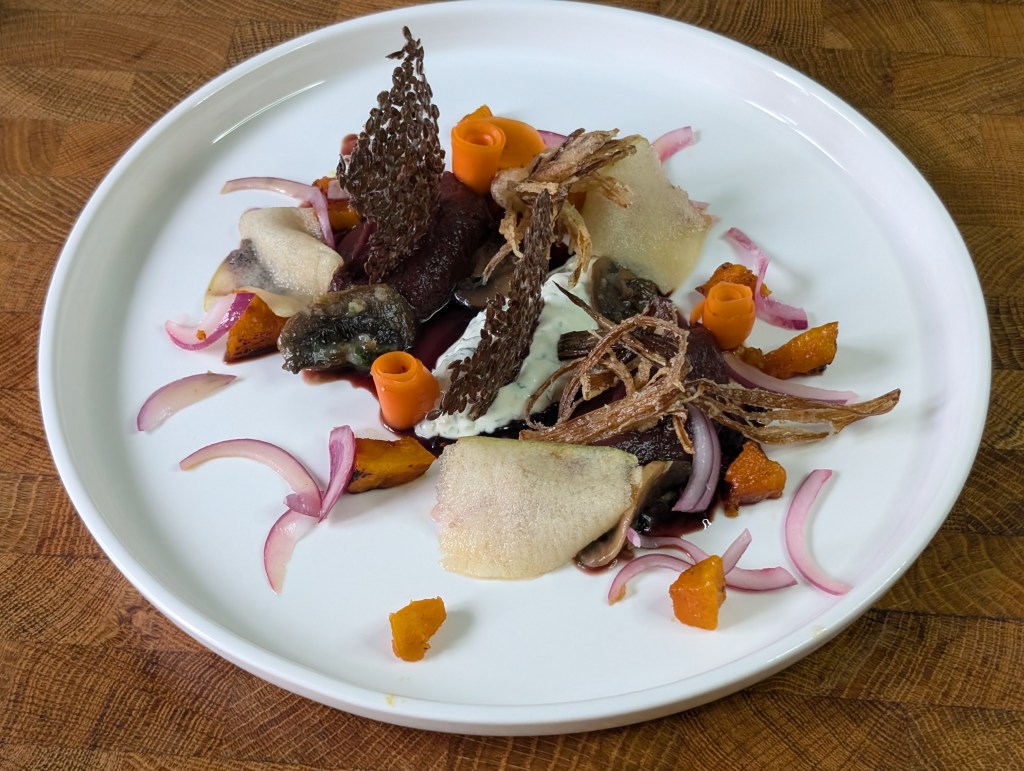
It also matched the other side of the dish perfectly. The ‘main’ portion of the dish (and yes, I put this in quotes because really both are equally as important as the other) was a sweet, sour and rich plate of exciting places you can take vegetables. Braised red cabbage puree was always planned for the dish as I knew it would provide the perfect purple colour and represent Miss Agatha Harkness herself, who—if you’re aware of Wandavision or Agatha All Along—you’ll know is the colour of Agatha’s magic and very much a representation of her (you even see purple colouring when you reach her trial in ‘Agatha’). I added cooked beetroot to this to help with giving a bit of body to the puree and to add our first layer of ‘Earthiness’ to our ‘Witches’ Road’.
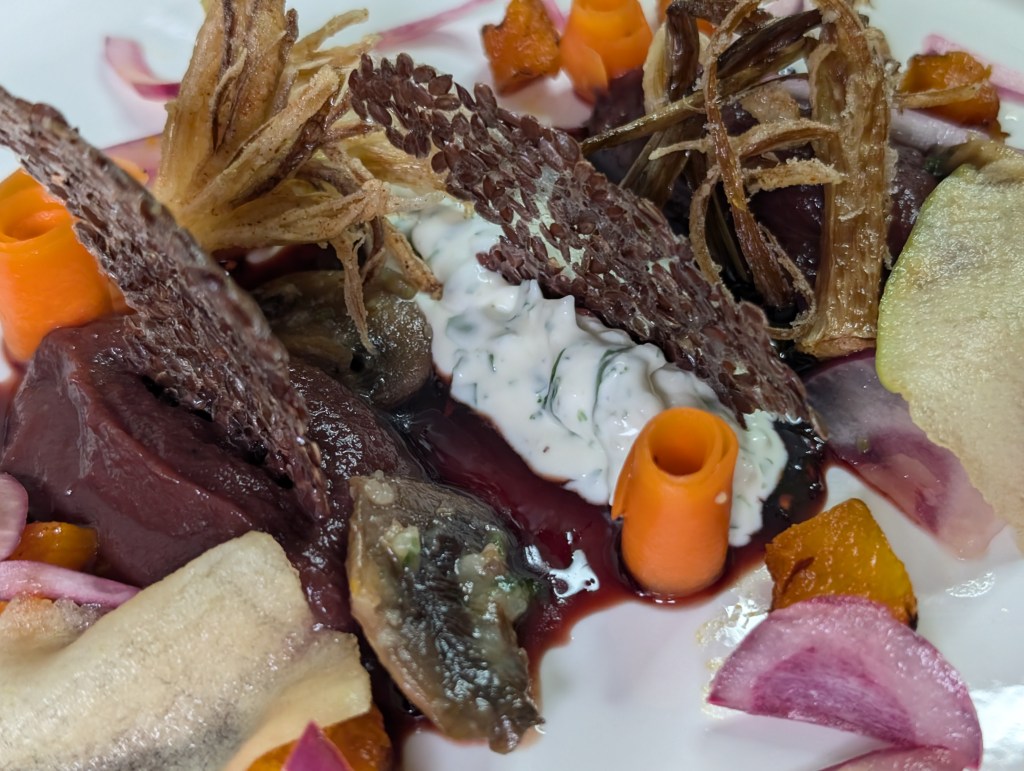
I also added a generous amount of wine to represent the poison in the show. Unfortunately, though I went looking for Rioja in multiple supermarkets, I couldn’t find any and so—with a bit of research into the Witch Trials in France—I settled on a nice Bordeaux, where the last recorded ‘witch/warlock’ was charged and punished in France. (It was actually quite hard to find connections with Witch Trials in France as, according to the Internet, the main Paris-based legislature didn’t recognize witchcraft as a punishable offence, and certainly not by death. The main places recorded where witch trials occurred were seemingly on the borders that they shared with other countries and the wines in those areas were all white wines, when I needed a red. Look it up. It’s actually quite fascinating. And it’s not to say Witch Trials didn’t happen, it’s just that they weren’t recorded because they would have been done by individual communities—Anyway, history lesson over, let’s get on with the dish)…
Pumpkin was obviously in the original version of the dish, with a new tweak. Instead of pureeing it or just having roasted chunks they were instead cubed, roasted and then blowtorched to give them black edges that resemble Wanda, Agatha’s and even Teen’s fingers in the first episode (Darkhold users, bar Teen—that we know of anyway). They were then coated in a ginger and chilli caramel to add a bit of heat and spiciness to the dish as well as an added kick of sweetness. The chilli also served as a reminder of fire and magic, as references to women burned at the stakes, Alice’s mother’s death, and Alice’s magic/curse. Can you tell who my favourite character in ‘Agatha’ is yet?
Apples, again an Autumnal fruit, were pickled in cider vinegar and honey along with carrot ribbons to add a pop of colour and a sour edge to balance against the sweetness of the pumpkin and other sweet editions. As a bonus they were also peeled in a way to make them appear to be like fallen leaves off a tree onto a forest floor. Lime-pickled onion was dotted around, again as a reminder of fallen leaves, to add another flavour of pickle and to add another boost of purple to the dish (after all, the dish is Agatha’s all along). Mushrooms were fried in a pan along with butter, garlic, herbs and marmite to add a meatiness to an otherwise sweet and sour dish—and to represent the mushrooms growing in a dark woods like the ‘Witches Road’. To balance out the dish and to add more floral notes (which I would have got from the crispy sage leaves I had to leave off when I couldn’t get sage) I made a quick herb cream out of thick, rich D’Isigny Cream and finely chopped parsley and the white part of my scallion/spring onion (along with a bit of salt and pepper).
For the base of the road, and to make the actual path the Witches follow, I made a coulis out of a handful of frozen raspberries, balsamic vinegar, blackcurrant/blackberry syrup (I couldn’t buy enough fresh fruit as it was ridiculously expensive) and the same Bordeaux wine from the braised cabbage to represent the poison again. I accidentally over-reduced it and added some extra water the next day to loosen it out but, after that quick fix, it painted onto the bottom of the plate perfectly and added a great smoky, fruitiness to the dish.
A last minute decision, borne out of needing to use up some scallions/spring onions I had in from another meal, I created little crispy deep-fried ‘trees’ for the ‘Wood’ by making little cuts along my scallions/spring onions, not quite to the bottom, letting them sit in a jug of water overnight so that they unfurled themselves, drying them, coating them in a spiced flour mixture and frying them at 190 degrees C. I then drained them and added one-to-two per dish (depending on their size) to create height, add another texture and to represent the trees the cast walk under in ‘Agatha All Along’ (which, after seeing episode 5, I realise I could also claim as being the ‘brooms’ the witches ride on to escape their pursuers).
The last part added to the dish was an idea that was already around from the first iteration. I knew I wanted to represent the final member of their coven, the member that Agatha didn’t want to include and tried to hide from the other witches: I wanted the dish to be topped with a Black Heart, to show that Agatha can’t escape from Lilia’s premonitions or from her past. It took me a week or so to figure out how to go around doing this until I remembered the linseed crackers I’d made a few years ago. I first tried Linseed crackers when I ate at ‘Roots’, Tommy Banks’ restaurant in York, UK and then found a recipe of how to make them not long after. I find them tasty, fairly easy and reasonably cheap to make since they only require one ingredient (not including salt)—They’re also perfect to represent a ‘black’ heart as they’re dark brown in colour and they provide another crispy texture on top of the otherwise heavily creamy plate. Two of these perched inside the puree and the cream were the crowns on top of the dish, making the autumnal ‘Agatha All Along’ dish reach it’s tasty conclusion.

I couldn’t be happier with how this one turned out. It was my first ‘Starter course’ Stories-Turned-Into-Food and the first one I filmed for YouTube and Instagram and, though I had to do it over a few days and had to figure out how to film whilst I cooked, I’m so proud of the dish—especially considering it’s all vegetarian (done on purpose to represent a ‘Wood’ full of vegetation). I love playing with all you can do with vegetables. Unlike meat, which is tasty on it’s own right and so is often cooked simply, you can do endless creative things with a basic vegetable.
Alright, alright, I’ll stop harping on about how much I love vegetables now. Thank you for reading this long post. If you want to see a more in depth look at the making of this dish then please consider going to watch our FIRST (screaming for emphasis) STORIES TURNED INTO FOOD VIDEO on YouTube and/or Instagram (links to be added by me later). Stories Turned Into Food is a labour of love that, when an idea comes, I love to do—and it also takes a while as there’s a lot of planning, research, prepping and finding some way to eat up a large quantity of food between three people to do before I can post one of these. That’s not even counting the length of time it then takes to write and edit these posts and to now edit long videos of footage down to a more bearable viewing time. If you do want to support these posts please feel free to donate to this blog, and/or subscribe to our YouTube channel (I’m not used to doing shameless plugging. Am I doing this right?). Again, thank you for reading and I hope you’re having a great day.
Signed,
The Literary Onion
If you want to see the YouTube version, click here: https://youtu.be/5FB71Po83fU . Thank you in advance.
P.S. Seriously, if I suggest you make anything, make the Onion broth. It’s really tasty and comforting. How are you enjoying ‘Agatha All Along’? I’ve been seeing mixed reviews which, I think means, it might be a more Marmite-y style show. You either love it or hate it. As for writing quality, other than a few blips that I would personally change, I think the quality has been pretty good. Unlike ‘Secret Invasion’ (that, based on my reviews ending you may have realised I stopped watching towards the end from sheer annoyance at the writing quality) I can at least say that the quality of writing, acting, and directing seems to be of a good—even great- standard. I may or may not do a review when it’s all ended but until then I’ll just enjoy theorising every week. Okay… Bye.

 The Literary Onion